Our Statement on the Under-16’s Social Media Ban
From young people’s perspectives.
The UK government have recently passed a ban on social media access for under-16’s, a decision said to be backed by “9 out of 10 parents” - a statistic reported in a press release on the UK Government website. The ban is expected to come into force starting Spring 2027.
The idea is that the ban will give kids “less time for scrolling and more time for play.”
The response to this has been mixed, as some believe that this will help combat online bullying and radicalisation, but we ask where kids and young people are supposed to go as an alternative when third spaces, such as youth clubs, are so sparse and under-funded?
The National Youth Sector Census published in late 2025 shows that there is an ever-growing pressure on youth services, with many orgs reporting a substantial increase in operating costs and a decline in their funding/operating budgets.
At Comics Youth we believe wholeheartedly in keeping youth voice at the centre of our mission, allowing young people to be the leaders they deserve to be!
Therefore, we have been having conversations about how the ban will impact us as young people.
Our Social Media Marginal Associate Jake has been working to build our social platforms to be a safe, welcoming space for our young people.
He has written the following statement based on his own lived experience and expertise regarding social media platforms:
“Working on social media has taught me a lot about its importance in current society. While there are unmistakable concerns with young people's use of social media and accessing content not appropriate for their age, coming face to face with extreme views and unhealthy habits. However, a straight up ban could bring up more issues and concerns, not just for the safety of young people.
In my opinion an overall ban of young people from social media would create a bigger safety concern. Taking young people off social media will cause it to become an 18+ space, most likely with less restrictions in place from the actual companies. Any young person who manages to bypass the ban, which has already become an issue with the current measures in place, would then have unrestricted access to a space that does not have their best interest in mind, leading to a greater risk of being exposed to unsafe content. It has already been found in Australia, who were the first to implement a ban, that young people are still able to access social media but in a much less filtered way as then the software believes them to be above the age of 18.
Along with the ban being used to stop young people from accessing harmful content it is also causing the blockage of educational and safe content. Firstly, the places being banned includes YouTube, somewhere I went to help understand things I have been taught since high school, I even used it up to university. Banning a place that can be used to expand people's education, help them understand a topic taught in school, or simple to learn something new, can be detrimental to people's education and desire to learn.
Other places containing information have already been restricted including reddit forums about periods and where to find mental health support with the website being banned all together with the new law.
Our own organisation uses social media to advertise our services so that young people/parents of young people who need our support can find us and reach out. Taking away social media from young people, and restricting educational content will cause issue for understanding around politics, especially when the voting age is down to 16, creating ill-informed voters who don’t know the policies of different parties and who to vote for. In my opinion it is very Orwellian.
Finally, how do adults get around the ban? The idea is to bring in digital ID, but currently and for the meantime social media use a range of methods to verify a person’s age, including facial recognition, providing driving license/passport or even using a credit card. These come with many of their own issues. For starters people may look older or younger than their age, making it hard for facial recognition to determine how old the user is. It also cannot register on individuals who have facial differences, including stuff such as scarring and cleft lip, making it a discriminatory process that may force individuals to use other methods of ID.
The other processes of identifying a person's age may be less discriminatory but come with their own risk. In January 2026 there was already a data leakage of people's id’s that had been stored from these very processes, despite social media companies claiming this information isn’t stored. This could lead to issues of stolen identity or even theft from people's bank accounts. Forcing people to share sensitive information always comes with the risk of it being exploited, shared or hacked, and the creation of digital ID will not negate this issue, it just creates another form of ID with all the same information on it that can be more easily hacked as it is stored online.
In the end, this is a very basic view of the social media ban and my opinion around it, if I was to talk about everything this blog would be huge. It is also important to do your own research and formulate your own opinion on the topic; I hope this gave a bit of information but also brought up more questions that you want answering before deciding.”
The following comic was written and illustrated by our Comic Artist Marginal Associate, Matt W. - in it he explores his own experience with using the internet to connect with likeminded people.
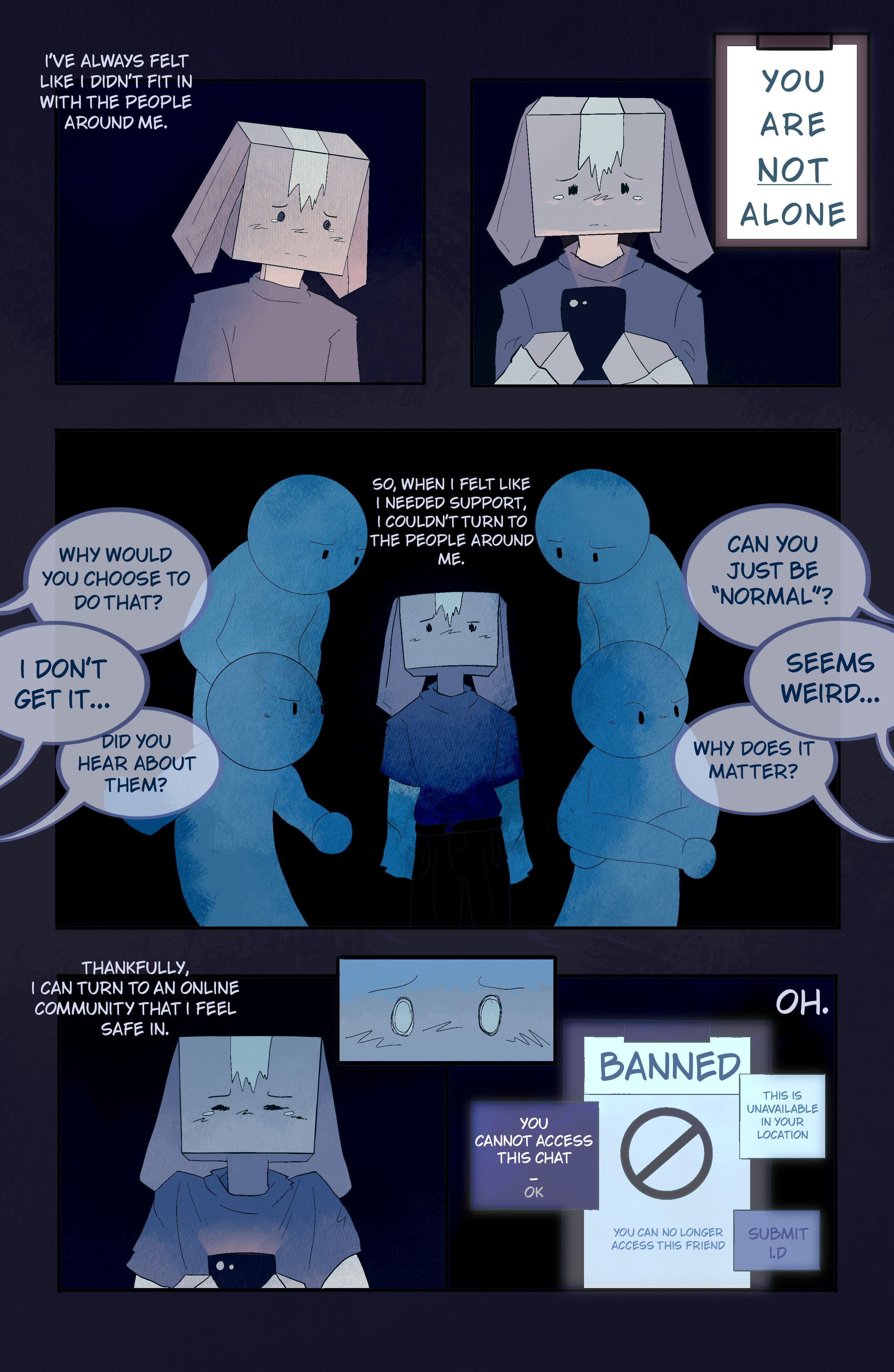
If you or someone you know is struggling with online bullying, or what the social media ban will bring, you are not alone.
Below are links to websites which can provide support:
Childline - a free, private confidential service for anyone under 19 based in the UK: Childline | Free counselling service for kids and young people
Kooth - offers free online support and a forum space to talk to like-minded young people for ages 10-25: Home - Kooth
Mind – a national mental health charity with both in-person locations and online support. Provides services for a wide range of ages, including young people: We're Mind, the mental health charity | Mind
Bernado's – UK charity which provides free support for children and young people, with over 650 specialist services across the UK: Who we are | Barnardo's
The Mix – provides essential support for under 25's in the UK, such as free one-on-one web chats, support groups and advice on their website: The Mix
YoungMinds - UK mental health charity providing free online support for young people aged 25 and under, and parents: YoungMinds | Mental Health Charity For Children And Young People | Young Minds